

WELCOME TO THE INSTALL.
Most coaching development only gives you information. we actually give you the tools & skills to thrive.
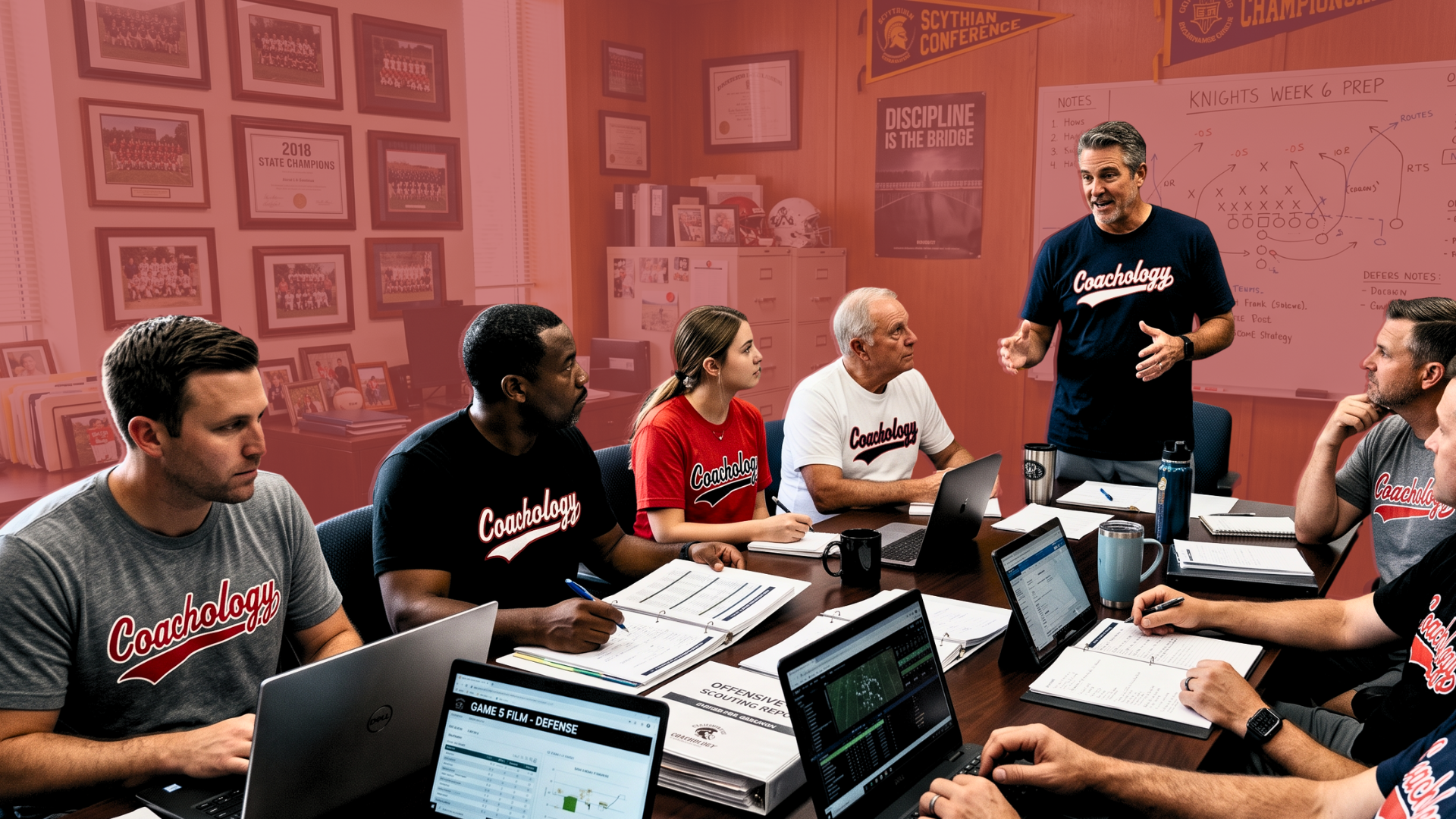
Coachology is a structured leadership curriculum built specifically for coaches; sequenced deliberately, grounded in how adults actually learn, and designed to produce tools your program uses after the session is over.
See below for the science of leadership, blended with the art of coaching. If you’re ready now, so are we. Contact us to get the Coachology Curriculum installed to your program.
THE COMPLETE COACH LEADERSHIP SERIES
Five modules. Five leadership layers. Sequenced deliberately — because the order matters.
The Complete Coach Leadership Series is the foundation of the Coachology curriculum. It was built on a single observation: most head coaches were promoted because they were excellent football coaches. Nobody promoted them because they were trained to lead a staff.
The Series addresses that gap — not with motivation, not with generic leadership principles, but with five specific frameworks installed in a specific order. Each module builds the leadership layer the next one depends on. You cannot hold your staff accountable to something you never clearly communicated. You cannot develop coaches you have never learned to delegate to. You cannot run a program as a system if you are still in the middle of every decision.
The Series follows that logic from the first module to the last.
MODULE 01 - CAST The vision
Does your staff know where you are going — and can they lead toward it without you in the room?
The C.A.S.T. Framework:
C — Clarify | Define the vision with enough specificity that your staff can execute it without asking you
A — Align | Build the shared language and shared standard your staff operates from
S — Sustain | Create the mechanisms that keep the vision alive past the first week of camp
T — Transfer | Install the vision into daily operations so it runs without you in the room
MODULE 02 - Lead the room
Can your coordinators lead when you are not in the room?
The I.D.E.A. Framework:
I — Identity | Define what leadership looks like at every level of your staff
D — Delegation | Build a delegation system that develops people instead of just distributing tasks
E — Execution | Establish the standards that tell your staff what good looks like
A — Accountability | Create the structure that holds commitments in place without requiring your constant presence
MODULE 03 - Hard Conversations
Are you having the conversations your program requires — or managing around them?
The S.A.Y. I.T. Framework:
S — See It | Name the actual problem, not the symptom
A — Acknowledge It | Open the conversation without triggering defensiveness
Y — Your Move | State what you need and own your part in it
I — Install It | Build the agreement that makes the conversation stick
T —Transfer It | Follow up in a way that holds the commitment in place
MODULE 04 - Build Your Staff
Is your program developing the next generation of leaders — or managing the ones you have?
The C.U.L.T.U.R.E. Framework:
C — Climate | Build a staff environment where development is expected, not optional
U — Understand | Know where each coach is in their development — not just in their role
L — Level | Identify the leadership ceiling each coach is working against
T — Task | Assign responsibilities that develop people, not just tasks that get done
U — Unpack | Create the reflection structures that turn experience into growth
R — Raise | Actively develop coaches toward the next level of responsibility
E — Embed | Make development a structural part of how your program operates year-round
MODULE 05 - The Executive Coach
Does your program run as a system — or does it run on you?
The S.Y.S.T.E.M. Framework:
S — See What’s Actually Running | Audit what runs without you and what collapses when you step away
Y — Your Role in the Gap | Identify where your presence is load-bearing and why
S — Structure It | Build the operational architecture that holds the program together
T — Transfer It | Move responsibility for program systems to the structure, not the person
E — Embed the Rhythms | Establish the recurring practices that keep the system running
M — Measure What’s Running | Build the visibility tools that tell you how the program is operating without requiring your presence
The coachology gameplan
The Series develops you as a leader. The Gameplan develops the environment you lead.
The Coachology Gameplan addresses the five domains every head coach manages outside the staff room. Where the Series focuses on how you lead your staff, the Gameplan focuses on how you run the program they operate in.
The two systems are designed to work together. We recommend completing the Series first as a foundational layer to build upon. The Gameplan can be engaged any time, but requires a strong leadership infrastructure underneath it for lasting results. Regardless of where you’d like to start, Coachology is here to help you and your coaching staff thrive.
The coach who completes all five Gameplan modules has built a complete operating system for the coaching environment — the parent system, the player system, the mental performance system, the practice system, and the development system that grows the coaches running all four.
ELEMENT 01 - the parents
Are you managing your parent relationships — or leaving them to chance?
The A.H.E.A.D. Framework:
A — Anticipate | Identify the parent situations that are coming before they arrive
H — Huddle Early | Establish the relationship before the problem does
E — Establish Your Lane | Define your role and your staff's role in parent communication
A — Align Your Staff | Make sure every coach communicates the same way
D — Define the Path | Give parents a clear, structured process for every concern
ELEMENT 02 - the players
Does your program have a standard — or does it have a preference?
The 3-Part Player Expectation System:
The Standard | What exactly is expected — defined with enough specificity that there is no gray area
The Why | Why it matters to the program and to the player specifically
The Consequence | What happens when the standard is not met — stated clearly before it needs to be enforced
ELEMENT 03 - the Mental Performance
Are you preparing your players to perform — or just hoping they will?
The M.E.N.T.A.L. Framework:
M — Map | Identify where your players are mentally and what is driving it
E — Establish | Build the mental foundation the rest of the framework stands on
N — Name | Give your players the language to identify and communicate what they are experiencing
T — Train | Develop mental skills through structured repetition, not hope
A — Anchor | Connect mental training to the specific high-pressure moments your players will face
L — Lock | Embed the mental framework into how your program prepares, competes, and recovers
ELEMENT 04 - The Practice
Is your practice producing skill — or just filling time?
The D.R.I.L.L. Framework:
D — Define the Standard | Establish the explicit standard for every period before practice begins
R — Real Speed, Real Pressure | Design reps that replicate what Friday actually demands
I — Immediate Correction | Build a correction loop into the rep, not after it
L — Layer the Load | Progress the complexity of what you ask players to execute as the week builds
L — Link to Transfer | Connect every rep to the game situation it is preparing players for
ELEMENT 05 - Professional Development
Is your staff growing on purpose — or by accident?
The C.R.A.F.T. Framework:
C — Calibrate the Rhythm | Establish a development cadence that runs as a program system, not an afterthought
R — Run the Reps | Build the deliberate practice structures that produce actual growth
A — Assess the Gap | Identify where each coach is and what the program needs him to become
F — Forge the Standard | Define what development looks like for every coach at every level of your staff
T — Transfer It | Embed the development system into how the program operates year-round
not sure where to start?
No pitch. Just a diagnostic.
Every Coachology engagement begins the same way — a conversation. Tell me what is happening in your program right now. We will identify the right module, the right entry point, and the right tier for where you are.